-
-
-
中国河北省安平县城东开发区红星路 1 号
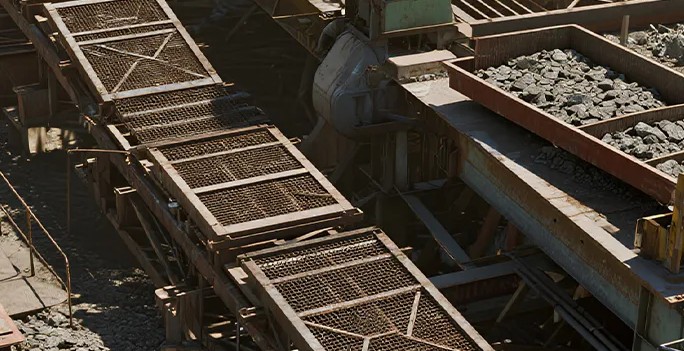
Mineral screens play a vital role in the construction industry, particularly in sand and gravel aggregate production, concrete preparation, construction waste recycling, and environmentally friendly building material processing Their application not only improves the quality of building materials and engineering efficiency, but also contributes to the realization of green building and sustainable development goals
Functional requirements:
Aggregates of sand and gravel used in construction must meet strict grading standards (such as the fineness modulus of sand for concrete and the distribution of crushed stone particle size). The ore screen uses multi-stage screening (coarse crushing, medium crushing, and fine crushing) to grade natural ore or machine-made sand according to particle size to ensure that the aggregates meet the needs of different projects (such as C30 concrete, roadbed filling, etc.).
effect:
Improve concrete strength: Accurate screening reduces coarse or fine particles and optimizes aggregate grading;
Reduce cement usage: Reasonable grading reduces aggregate void ratio and saves cementitious material costs.
Crushing and screening system:
Mineral screens are used to sort construction waste (concrete blocks, bricks, tiles, steel bars, etc.), separate recyclable aggregates from impurities, and produce recycled aggregates (such as RCA recycled concrete aggregates) for road bases, non-structural concrete, etc.
effect:
Reduce landfill volume: the recycling rate of construction waste has increased to over 70%;
Save natural resources: replace natural sand and gravel to alleviate the pressure of resource shortage.
A. Screening of lightweight building materials:
In the production of lightweight aggregates such as expanded perlite and ceramsite, mineral screens are used to control particle size to ensure that thermal insulation and sound insulation performance meet standards.
B. Screening of decorative materials:
Screening of natural stone fragments (such as marble and granite) for use in artificial stone slabs or landscape paving to increase added value.
Raw material quality control:
Screening of sand, fly ash, mineral powder and other raw materials to remove lumps or impurities to ensure uniformity and construction performance of concrete and mortar.
(1) Common screen types
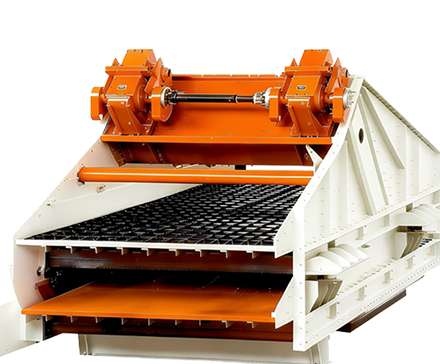
A. Vibrating screen (linear screen, circular vibrating screen):
It is suitable for high-yield sand and gravel aggregate grading, with a processing capacity of up to 1,000 tons/hour. The multi-layer screen design (such as 3-5 layers) realizes the synchronous output of multiple particle sizes.
B. Drum screen:
Used for the preliminary sorting of construction waste, separating large debris and recyclable aggregates through a rotating screen drum.
C. High frequency screen:
Focus on fine sand recovery (such as stone powder control in machine-made sand) to reduce resource waste.
A. Wear resistance:
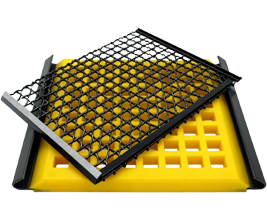
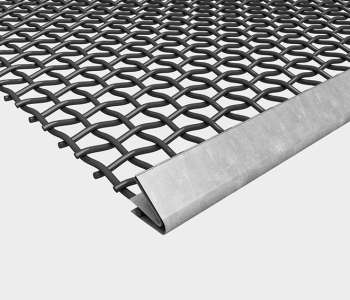
Sand and gravel aggregates have high hardness (Mohs hardness 6-7), so the screen needs to be made of high manganese steel, polyurethane or rubber edging material to extend its service life.
B. Anti-blocking hole design:
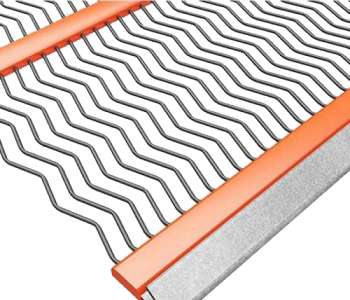
During wet screening, a wavy screen surface or a bouncing ball screen cleaning device is used to reduce sand adhesion and clogging.
C. Modular structure:
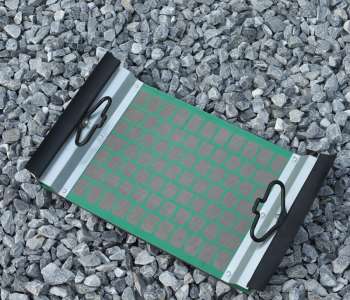
Quickly change the screen specifications (such as 4mm, 10mm aperture) to adapt to different project requirements.
选择取决于物料硬度、含水量、颗粒大小和冲击力:
潮湿或粘性物料 → 聚氨酯筛网(防堵塞)
高磨损物料 → 锰钢编织网或冲孔板
高精度筛分 → 不锈钢编织网
重冲击物料 → 钢边聚氨酯板或橡胶筛板
选择正确的筛网可以提高产量并减少停机时间。
使用寿命随物料磨蚀性、振动频率、安装张力和筛网类型而变化:
聚氨酯筛网:3-12 个月
锰钢筛网:1-6 个月
不锈钢筛网:2-8 个月
橡胶板:4-12 个月
正确的张紧和选择合适的孔径可显著延长使用寿命。
堵塞由于水分、不规则颗粒形状或不合适的孔径设计引起。 预防方法:
使用自清理筛网(波浪型或琴弦型)
更换为聚氨酯防堵塞筛网
调整振动振幅和筛面倾角
对潮湿或泥泞物料进行预筛分
防堵塞解决方案大大提高了筛分效率。
更换期间的关键点包括:
确保整个筛网的张力一致
检查筛框是否有变形
钩子类型或紧固系统与您的筛机匹配
清理筛床以清除残留物料
正确的安装可减少破损并提高筛分精度。
筛分效率可以通过以下方式提高:
选择合适的孔径和筛网材料
调整振动频率和筛子倾角
保持均匀的物料进给
使用多级筛分设计
定期维护筛床和筛网
通常可实现 10-30% 的效率提升。